Evidence-Based & Medically Referenced
Fiber supplements for IBS and SIBO: psyllium, bran and more
On this page
In short: soluble fiber, and psyllium in particular, is the fiber supplement with the best evidence in irritable bowel syndrome (IBS). In a 2026 analysis of 16 placebo-controlled trials, 52% of people responded to fiber compared with 44% on placebo, and psyllium was the one type with a clear benefit of its own1. Wheat bran, an insoluble fiber, did not help in an earlier analysis2, and the British IBS guideline advises avoiding it3. Psyllium is only slowly fermented and produced little gas in imaging studies4, which is why it is usually better tolerated than bran or inulin. There are no trials of fiber supplements in people with SIBO, apart from one trial of partially hydrolyzed guar gum given with an antibiotic.
Fiber is often the first thing people with IBS are told to try, and also the first thing many people with SIBO are told to avoid. Both pieces of advice can be right, because “fiber” covers very different substances. This guide explains which types help bowel habit and which tend to cause gas, what the trials show for psyllium, bran, methylcellulose and guar gum, how to start a supplement, and how fiber fits with SIBO and the low-FODMAPFODMAPs Fermentable oligo-, di- and monosaccharides and polyols: short-chain carbohydrates that are poorly absorbed and quickly fermented by gut microbes. diet.
Soluble vs insoluble fiber
Dietary fiber is the part of plant food that the small intestine cannot digest. It reaches the colon (large intestine), where some of it is fermented: gut bacteria break it down and release gases such as hydrogen and carbon dioxide, along with short-chain fatty acidsShort-chain fatty acids (SCFAs) Compounds such as butyrate, acetate and propionate that gut bacteria make by fermenting fiber. They fuel the cells lining the colon and help regulate inflammation. that feed the cells lining the colon. Fibers differ in three ways that matter for IBS:
- Solubility. Soluble fibers dissolve or swell in water. Insoluble fibers, such as wheat bran, stay mostly intact and add bulk.
- Viscosity. Some soluble fibers, psyllium among them, form a thick gel that holds water in the stool. Others, such as inulin and partially hydrolyzed guar gum, dissolve without thickening much.
- Fermentability. Short-chain fibers such as inulin and galacto-oligosaccharides are fermented quickly and produce gas early. Psyllium is fermented slowly because its structure limits bacterial access4.
The fibers that help IBS most in trials are soluble, gel-forming and slowly fermented. The ones most likely to cause trouble are either insoluble (bran) or rapidly fermented (inulin, FOS and GOS, which are also FODMAPs).
What the trials show
Several meta-analyses, which pool the results of many trials, have reached the same conclusion:
- 2014: an analysis of 14 randomized trials with 906 people found fiber helped IBS overall, but the benefit came from soluble fiber. About 1 in 7 people treated with soluble fiber improved who would not have on placebo. Bran had no significant effect, although the analysis found no evidence that it caused harm2.
- 2026: the most recent analysis included 30 placebo-controlled trials with 1,904 people. The most studied fibers were wheat bran (7 trials), psyllium (6), inulin-type fructans (5) and galacto-oligosaccharides (2). In the 16 trials that counted responders, 52% responded to fiber and 44% to placebo. Psyllium improved the response rate by about half (risk ratio 1.53). Scores of overall gut symptoms did not improve significantly across fibers, except with galacto-oligosaccharides. Most trials did not report results by IBS subtype1.
The largest single trial compared psyllium and bran directly. In 2009, 275 people with IBS in general practice took 10 g a day of psyllium, bran or a rice-flour placebo for 12 weeks. More people had adequate relief with psyllium than placebo in the first month (57% vs 35%) and second month (59% vs 41%), and symptom severity fell by 90 points with psyllium compared with 49 with placebo. Bran was better than placebo only in the third month, and that result did not hold up in a stricter analysis. People on bran were the most likely to drop out early, mainly because their symptoms got worse5.
Guideline recommendations
- The 2021 American College of Gastroenterology guideline recommends soluble, but not insoluble, fiber to treat overall IBS symptoms6.
- The 2021 British Society of Gastroenterology guideline describes soluble fiber such as ispaghula (another name for psyllium) as an effective first-line treatment for overall symptoms and abdominal pain, advises avoiding insoluble fiber such as wheat bran because it may make symptoms worse, and recommends starting at a low dose of 3 to 4 g a day and building up gradually to avoid bloating3.
Psyllium for IBS-C, IBS-D and bloating
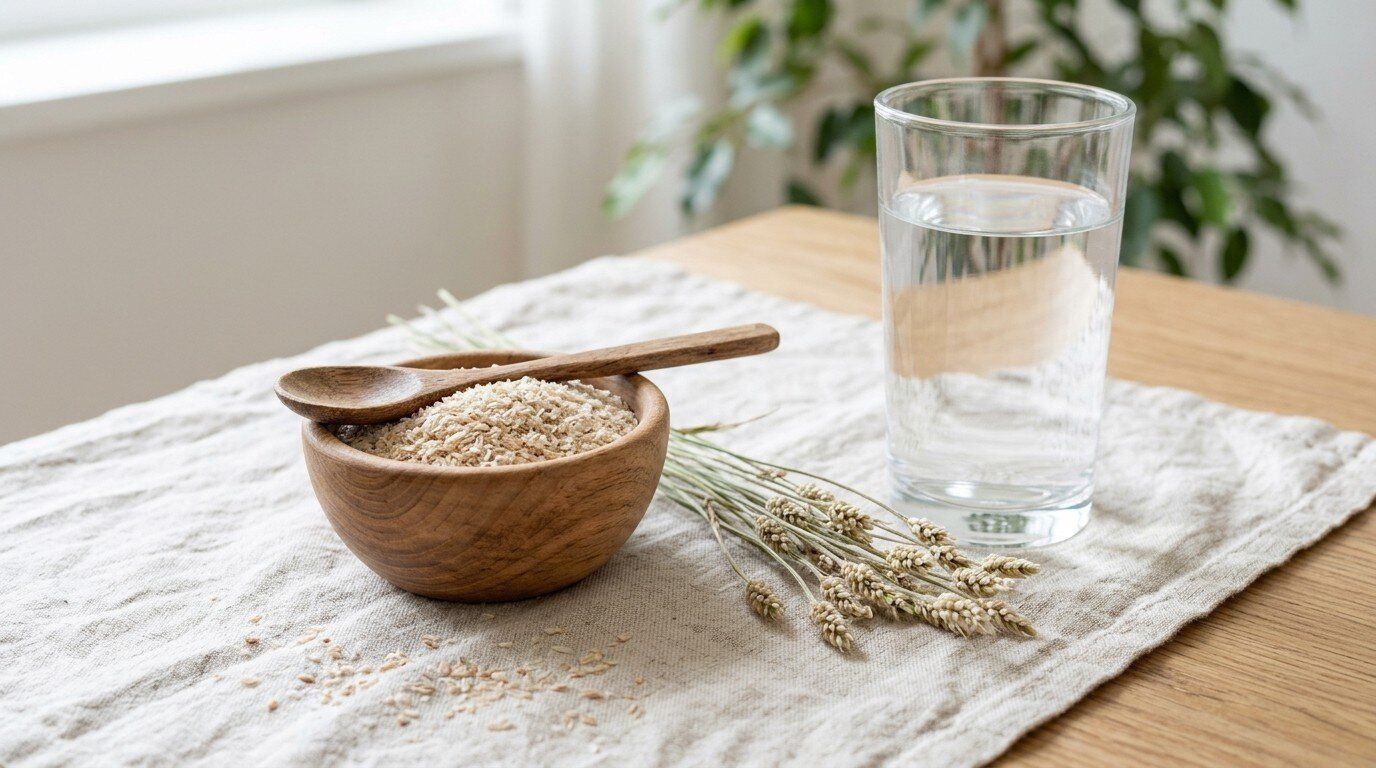
Psyllium (ispaghula husk) is the husk of Plantago ovata seeds. It is sold as a powder, capsules and wafers, often under brand names such as Metamucil. It absorbs water and forms a gel, which softens hard stool and can firm up loose stool. Its effects differ by IBS subtype.
IBS with constipation (IBS-C). The evidence is strongest here. In a 1987 double-blind trial of 80 people with IBS, 82% rated ispaghula satisfactory compared with 53% on placebo; constipation and gut transit time improved only with ispaghula7. Constipation guidelines agree: the 2025 British Dietetic Association guideline, based on randomized trials in chronic constipation, found psyllium increased the number of people who benefited, made stools more frequent and softer, and reduced straining8.
IBS with diarrhea (IBS-D). The evidence is thinner. Psyllium’s gel holds water, and in a 1998 study of 8 healthy volunteers given the laxative sugar lactuloseLactulose A synthetic sugar the body cannot digest or absorb. As a breath-test substrate it travels the whole small intestine, which also makes false positives more likely., psyllium slowed gastric emptying and transit through the colon9. In a 1987 dose study in people with IBS, ispaghula improved constipation and pain more than diarrhea10. In a 2022 pilot trial of 37 people with loose stools and fecal incontinence, 6 g a day of psyllium cut accidents by at least half in 50% of people, a similar rate to a low-FODMAP diet (39%)11. No large trial has tested psyllium in IBS-D alone, and the 2026 meta-analysis could not separate results by subtype1.
Pain. In a 2017 double-blind trial in 84 children and teenagers with IBS, 6 weeks of psyllium reduced the number of pain episodes about twice as much as placebo. Breath hydrogen and methane did not change12.
Bloating. Psyllium does not reliably relieve bloating, but it does not usually cause much either. In the 1987 trial, bloating improved about equally with ispaghula and placebo7. The 2025 constipation guideline found fiber supplements as a group increased flatulence but not bloating, and suggests kiwifruit as an alternative for people who get bloating, pain or wind with psyllium8. Psyllium labels warn of “minor bloating as your body adjusts to increased fiber intake”13, which is why a slow start matters.
Why psyllium causes less gas
Imaging studies show what happens in the gut. In a 2022 crossover trial, 19 people with IBS drank 20 g of inulin, 20 g of psyllium, both together, or a placebo, and had MRI scans every hour for 6 hours. Psyllium alone increased the volume of the colon without raising colonic gas or breath hydrogen. Inulin caused the largest rise in colonic gas, and adding psyllium to inulin cut that rise to a level not significantly different from placebo. In laboratory tests with stool from people with IBS, psyllium produced less gas than inulin4.
Psyllium does not stop fermentation; it slows it down. A 2025 trial in 17 healthy adults found psyllium delayed the rise in breath hydrogen from inulin but did not reduce the total over 24 hours, apparently by slowing inulin’s arrival in the colon14. These were short studies with single doses. Whether taking psyllium with meals makes FODMAP-rich foods easier to tolerate over weeks has not been tested.
Other fiber supplements
Methylcellulose is a semi-synthetic fiber made from plant cellulose that bacteria cannot ferment. It is sold as a bulk laxative (for example, Citrucel). Trials in IBS are few. In a 2013 exploratory primary-care trial of 135 people with IBS, methylcellulose capsules for 6 weeks were no better than placebo on symptom scores15. In a 2026 crossover trial in 22 healthy volunteers, a methylcellulose gel reduced the colonic gas produced by inulin about as well as psyllium and drew more water into the bowel16, although in a second trial of 30 healthy volunteers it did not slow the early rise in breath hydrogen as well as psyllium did17. Being non-fermentable, it is a reasonable option for people who get gas even from psyllium, but the evidence for IBS symptoms is weak.
Partially hydrolyzed guar gum (PHGG) dissolves without forming a thick gel. In a 2002 open trial of 188 people with IBS, half of those given wheat bran switched to PHGG after 4 weeks, compared with 11% who switched the other way, and PHGG was better tolerated18. In a 2016 placebo-controlled trial of 121 people with IBS, 6 g a day for 12 weeks improved bloating but not other symptoms or quality of life19. PHGG is also the fiber tested alongside an antibiotic in SIBO; see our prebiotics guide.
Acacia gum and inulin, FOS and GOS are mainly used as prebiotics, to feed beneficial bacteria, rather than to regulate bowel habit. Inulin-type fiber supplements did not improve stool frequency in constipation trials and increased flatulence8. Our prebiotics guide covers their evidence in SIBO.
Wheat bran is insoluble and fermentable. It did not help IBS in the meta-analyses2 and worsened symptoms in some trial participants5.
Comparison of fiber types
| Fiber | Type | Fermentation and gas | Evidence in IBS |
|---|---|---|---|
| Psyllium (ispaghula) | Soluble, gel-forming | Slow; little gas on MRI4 | Best: benefit in meta-analyses and guidelines1 |
| Methylcellulose | Soluble, semi-synthetic | Not fermented | Weak: no benefit in one small trial15 |
| PHGG | Soluble, low viscosity | Moderate; usually well tolerated | Moderate: helped bloating in one trial19 |
| Acacia gum | Soluble, low viscosity | Gradual | Not well studied in IBS; see prebiotics |
| Inulin, FOS, GOS | Soluble, short-chain (FODMAPs) | Fast; most gas4 | Mixed; GOS improved symptom scores1 |
| Wheat bran | Insoluble | Fermentable | No benefit; may worsen symptoms23 |
How to start and dose a fiber supplement
- Start low. The British guideline recommends 3 to 4 g of soluble fiber a day at first, increased gradually to avoid bloating3. One rounded teaspoon of a typical psyllium powder contains about 3.4 g of psyllium; labels advise new users to start with one dose a day and increase to three if needed13.
- Build up over weeks. Trials in IBS mostly used 10 to 20 g a day510. In constipation, doses above 10 g a day and at least 4 weeks of use worked best8. In a small 1987 dose study, 20 g a day of ispaghula worked better than 10 g, with no extra benefit from 30 g10.
- Take it with plenty of water. Mix each dose with at least 8 ounces (a full glass) of water or other fluid13.
- Space it from medication. Take psyllium at least 2 hours before or after other medicines taken by mouth, because laxatives can affect how other drugs work13.
- Give it time. In the largest trial, the benefit of psyllium was clear from the first month5. If symptoms are worse after a few weeks at a modest dose, try a different fiber or stop.
- Check the label. Flavored products can contain sugar or sweeteners. Sweeteners ending in “-ol”, such as sorbitol, are polyols, one of the FODMAP groups.
Safety
Psyllium is generally safe, but it swells quickly. Labels warn that taking it “without adequate fluid may cause it to swell and block your throat or esophagus and may cause choking”, and that people with difficulty swallowing should not take it13. Case reports describe blockages, for example a 76-year-old man with Parkinson’s disease, which can slow swallowing, who needed an endoscopy to remove a psyllium mass near the stomach20. Always take it stirred into a drink, never as dry powder.
Ask a doctor before starting a fiber supplement if you have abdominal pain, nausea or vomiting, or a change in bowel habit that has lasted more than 2 weeks, and stop and seek advice if you have rectal bleeding or constipation lasting more than 7 days13. These can be signs of something other than IBS. People with a narrowed bowel, previous bowel obstruction or severe slow motility should also check first.
Fiber and SIBO
There are no trials of psyllium, methylcellulose or bran in people with diagnosed SIBO. A 2026 review of SIBO diet recommendations from North America, South America, Europe and the Asia-Pacific region found that the role of fiber “is not clearly established and depends on the type of fiber and the clinical context”; guidelines either gave no clear recommendation or advised an individual approach, noting that excess fermentable fiber may worsen symptoms in some people21. The one controlled finding is for PHGG: added to the antibiotic rifaximinRifaximin An antibiotic that is barely absorbed into the bloodstream, so it acts mainly inside the gut. It is a common prescription treatment for SIBO., it raised breath-test normalization rates in a single small trial, covered in our prebiotics guide.
What can be said from the IBS research:
- Fermentable fibers are the ones likely to cause trouble. Inulin, FOS and GOS are fermented quickly and produced the most gas on MRI4. In SIBO, where bacteria are already present higher in the gut, these are the fibers most people find hard to tolerate.
- Psyllium is fermented slowly. It did not raise breath hydrogen or methane in children with IBS12 or colonic gas in adults4. That makes it a reasonable first choice if a fiber supplement is needed, but nobody has tested whether it changes SIBO itself.
- Constipation needs addressing. People with methane-dominant overgrowth, intestinal methanogen overgrowth, are often constipated. Cutting fiber too far can make constipation worse, and soluble fiber is one of the treatments with the best evidence for constipation8. Our guide to gut motility covers other options.
Practitioner approaches. These are based on clinical experience, not trials. SIBO practitioners commonly keep fermentable fiber supplements low during antimicrobial treatment, then add fiber back gradually afterwards, starting with less fermentable types such as psyllium or PHGG and moving to prebiotic fibers later. Many also ask patients to pause fiber supplements before a breath test, since test preparation involves avoiding fermentable foods for about 24 hours22; see our guide to breath tests and follow the instructions from the lab or clinic.
Fiber and the low-FODMAP diet
FODMAPs are fermentable oligosaccharides, disaccharides, monosaccharides and polyols, a group of short-chain carbohydrates that are poorly absorbed and fermented quickly. Psyllium is a long-chain polymer (an arabinoxylan) that resists digestion4, so plain psyllium is not a FODMAP. Inulin, FOS and GOS are. The low-FODMAP diet cuts out many high-fiber foods such as wheat, legumes and some fruit, and can lower total fiber intake and beneficial bifidobacteria.
Adding psyllium is one way to keep fiber up during the diet. In a small 2026 placebo-controlled trial, 26 people with IBS on a low-FODMAP diet took a blend of psyllium and resistant starch or a placebo for 3 weeks. Symptoms stayed stable, fiber intake rose, and gut bacteria changed, without the blend making symptoms worse23. The MRI studies suggest psyllium may also soften the gas response to FODMAPs eaten with it4, but this has not been tested as a long-term strategy.
Common questions
What is the best fiber supplement for IBS?
Psyllium has the strongest evidence. It is the only fiber with a clear benefit in the 2026 meta-analysis1, and both the American and British guidelines recommend soluble fiber over bran63. It works best for IBS with constipation.
Is Metamucil good for IBS?
Metamucil is a brand of psyllium, so the psyllium trials apply to it. Some versions contain sugar, sweeteners or flavorings; plain or unflavored psyllium avoids those. The same applies to other psyllium brands and to generic ispaghula husk.
Does psyllium cause bloating?
It can at first, especially at a high starting dose; labels warn of minor bloating while the body adjusts13. In trials, bloating was no worse than with placebo7, and psyllium produced little gas on MRI4. Starting at 3 to 4 g a day and increasing slowly helps3.
Can I take psyllium with IBS-D?
Yes, although the evidence is weaker than for constipation. Psyllium’s gel can firm loose stools, and it reduced accidents in people with loose stools in a small trial11. Start with a low dose.
Should I avoid fiber if I have SIBO?
Not all fiber. The fibers most likely to worsen gas are rapidly fermented ones such as inulin, FOS and GOS. Slowly fermented fibers such as psyllium are usually better tolerated, and stopping fiber altogether can worsen constipation. There are no SIBO trials of psyllium21, so let symptoms guide you and see our SIBO diet guide.
Is psyllium low FODMAP?
Plain psyllium is not a FODMAP, because it is a long-chain fiber rather than a short-chain carbohydrate4. Check flavored products for added FODMAPs such as inulin, chicory root fiber or polyol sweeteners.
When is the best time to take psyllium?
There is no best time of day from trials. What matters is taking each dose with a full glass of water and keeping it at least 2 hours apart from other medicines13.
Works Cited & Scientific References
23
▼
- Fiber supplementation in irritable bowel syndrome: a systematic review and meta-analysis of randomized controlled trials - Gastroenterology 2026 (PubMed)
- The effect of fiber supplementation on irritable bowel syndrome: a systematic review and meta-analysis - Am J Gastroenterol 2014 (PubMed)
- British Society of Gastroenterology guidelines on the management of irritable bowel syndrome - Gut 2021 (PubMed)
- Psyllium reduces inulin-induced colonic gas production in IBS: MRI and in vitro fermentation studies - Gut 2022 (PMC)
- Soluble or insoluble fibre in irritable bowel syndrome in primary care? Randomised placebo controlled trial - BMJ 2009 (PMC)
- ACG clinical guideline: management of irritable bowel syndrome - Am J Gastroenterol 2021 (PubMed)
- Double blind study of ispaghula in irritable bowel syndrome - Gut 1987 (PMC)
- British Dietetic Association guidelines for the dietary management of chronic constipation in adults - J Hum Nutr Diet 2025 (PMC)
- Moderation of lactulose-induced diarrhea by psyllium: effects on motility and fermentation - Am J Clin Nutr 1998 (PubMed)
- Optimum dosage of ispaghula husk in patients with irritable bowel syndrome - Gut 1987 (PMC)
- A randomized pilot study to compare the effectiveness of a low FODMAP diet vs psyllium in patients with fecal incontinence and loose stools - Clin Transl Gastroenterol 2022 (PMC)
- Psyllium fiber reduces abdominal pain in children with irritable bowel syndrome in a randomized, double-blind trial - Clin Gastroenterol Hepatol 2017 (PMC)
- Bulk-forming laxative (psyllium husk powder) Drug Facts label - DailyMed, US National Library of Medicine
- Mode of action of psyllium in reducing gas production from inulin and its interaction with colonic microbiota: a randomized, placebo-controlled trial in healthy volunteers - J Nutr 2025 (PMC)
- Management of irritable bowel syndrome in primary care: exploratory randomised controlled trial of mebeverine, methylcellulose, placebo and a self-management website - BMC Gastroenterol 2013 (PMC)
- Randomised placebo-controlled trial of methylcellulose and psyllium gels on inulin-induced colonic gas - Aliment Pharmacol Ther 2026 (PubMed)
- A randomised, placebo-controlled trial in healthy humans of modified cellulose or psyllium evaluating the role of gelation in altering colonic gas production during inulin co-administration - Food Funct 2026 (PMC)
- High-fiber diet supplementation in patients with irritable bowel syndrome: comparison between wheat bran diet and partially hydrolyzed guar gum - Dig Dis Sci 2002 (PubMed)
- Randomized clinical study: partially hydrolyzed guar gum (PHGG) versus placebo in the treatment of patients with irritable bowel syndrome - Nutr Metab 2016 (PMC)
- Acute esophageal obstruction after ingestion of psyllium seed husk powder: a case report - World J Clin Cases 2022 (PMC)
- Global perspectives on dietary management of small intestinal bacterial overgrowth (SIBO): a systematic review of clinical guidelines - Front Med 2026 (PMC)
- Constipation with bloating: a clinical approach to evaluation and management - Ann Med 2026 (PMC)
- Dietary fibre blend improves gut health in patients with irritable bowel syndrome following a low FODMAP diet: a randomised, double-blind control trial - Eur J Nutr 2026 (PMC)
Topics & Tags